
When workplace wellbeing is meaningfully and intentionally embedded as part of how an organisation works day to day, it shows. The Skate Sanctuary has been recognised as our Mindful Employer of the Quarter for creating a culture where emotional safety, honesty and belonging sit at the heart of everything they do. From clear, compassionate leadership to strong boundaries that actively protect staff, this is a small team making a big impact by putting people first in a very real, practical way.
Leeds Mindful Employer Network Project Lead, Leigh Staunton, caught up with Skate Sanctuary’s Visionary Creative Director, Melissa Blackwood, to talk about the win and the organisation’s approach to wellbeing at work. Check out Skate Sanctuary’s nomination and Leigh’s conversation with Melissa in full below.
How does it feel to win and read your nomination?
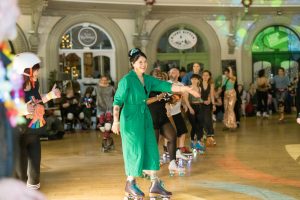
Melissa Blackwood, Visionary Creative Director at the Skate Sanctuary
It feels incredibly validating and quite emotional, to be honest. When you run a small business, you spend so much time with your head down, focusing on the day-to-day operations and just trying to do the right thing by your team. To see our internal culture recognized in this way means the absolute world. It tells me that the care we put into our team is actually being felt by them and that we have been recognised as a beacon of excellence.
Tell us a bit about you and your role at The Skate Sanctuary.
I’m Melissa Blackwood, the Visionary Creative Director of The Skate Sanctuary. My role wears many hats—from overseeing the business strategy and operations to being on the ground, including developing the coaching programmes, overseeing the schedule, funding applications, supporting the community, staff wellbeing and marketing. Ultimately, my most important role is setting the tone for our environment, ensuring it remains a safe, joyful, and inclusive space for both our skaters and our staff.
Why is mental health important to you, and how does that shape how you support employees?
Personally, I’ve experienced many different leaders and leadership styles, yet only one who had truly vulnerable leadership traits. As I worked through a leadership and management training programme – Help to Grow: Management at Leeds Beckett University, I realised that business leaders rarely have all the answers, they simply know who to ask for help. Recognising when to ask for help is the challenge – if the response is available on Google, we can frustrate our colleagues, if we wait for too long, we may have made the problem harder to solve.
As a business, I strongly believe that you cannot pour from an empty cup. If we want our team to provide a welcoming, uplifting experience for our community, we have to provide that exact same environment for them. Supporting them as ‘whole people’ means recognizing that they have lives, struggles, and joys outside of work. We accommodate flexibility where we can and make sure work is a supportive pillar in their life, not a source of drain or anxiety. Maintaining mental health is incredibly important, as we continue to be distracted by 1000 different things each day, learning to filter out what is right for us and make good decisions requires us to have a regulated nervous system. I’ve known for a long time that movement practices help me maintain positive mental health and in fact have been building a business around this for almost ten years.
Where did the mental health journey start at the Skate Sanctuary, and how has it evolved?
It started very organically. Roller skating naturally brings up a lot of vulnerability—people fall down, they feel self-conscious, and they have to build confidence. We realized early on that to support our customers, our staff needed deep emotional safety themselves. Every time we received feedback, we ensured we built this into our skating programmes. We are very clear about the community we do and do not serve – our skating programmes are not for everyone, due to the very personal, small-group coaching style. I became a Mental Health First Aider in 2020, as we realised there would be a mental health pandemic next and it’s one of the best training programmes I’ve ever completed. It invites a lot of self-reflection – always uncomfortable. Being able to sit with this discomfort is essential to being able to hold space for both yourself and others.
What made you sign the Mindful Employer Charter, and how has the renewal process been for you?
We signed the Charter in 2022 because we wanted to make a public, official commitment to our team’s wellbeing—it was about holding ourselves accountable. The renewal process was actually a fantastic tool for us. Instead of being a chore, it acted as a structured ‘health check’ for the business. It forced us to pause, reflect on what we were doing well, and identify areas where we can step up our support. Being an official Mindful Employer is a badge of honour; it signals to our staff and our community that our values are more than just words.
We’ve spoken before about how compassionate leadership and clear boundaries go hand-in-hand. Could you talk to us more about that?
Compassion doesn’t mean being a pushover; in fact, true compassion requires strong boundaries to protect the peace of the team. In practice, this means we have a zero-tolerance policy for disrespectful behaviour, whether from customers or within the team. If a customer is crossing a line, our staff know they are 100% empowered to enforce our rules, and they know management will back them up completely. We prioritize our team’s psychological safety over making a quick sale. In fact, where a customer has continued to escalate their behaviour, we have taken steps to cancel an order and refund them, asking them to shop elsewhere. We have taken similar actions within our skate spaces. As a minority gender staff team, we cannot have any doubts about personal safety within the workplace. Should staff overstep a boundary, we will first call them in with a conversation, and work with them to correct the issue or problem as best as we can.
“Clear is kind” – How does this influence difficult conversations?
That phrase (borrowed from Brené Brown) is a cornerstone of our culture. When expectations are vague, it breeds anxiety. By being upfront, transparent, and honest, we eliminate the guesswork for our team. When we need to have a difficult conversation, we approach it with empathy but without beating around the bush. We address issues early before they fester, and we frame feedback as a tool for growth, ensuring the person knows we are criticizing the action or the process, never their worth as a person.
As a small, part-time team, how do you create a culture of openness?
With part-time teams, the biggest risk is people feeling disconnected. We combat this by over-communicating in a positive way. We use a WhatsApp group and a weekly 30-minute meeting to keep everyone in the loop. I also maintain a very open-door policy. We make it clear that ‘part-time’ does not mean ‘part-valued.’ Their voices carry just as much weight, and we regularly ask for their feedback on how the business is running. At the end of every shift is a handover sheet for that team member to complete with a couple of words about what went well and what could be better, including asking for resources.
What are you most proud of regarding mental health at work?
I am most proud of a specific moment where the team rallied around someone who was struggling. It was clear that their behaviour had changed and they had become withdrawn. Fortunately, we had completed mental health action plans for staff (which are always voluntary) so I was able to refer to their plan to see how they would prefer to be supported. I have modelled completing mine and also asking for help (which being Gen X I find incredibly difficult, yet I know is so important to do). As we are such a small team, we do check that we are able to share these documents with each other, so we can spot the signs early. The action plan was provided at one of the local network meetings and was really valuable. Seeing the team naturally support one another without me having to facilitate it proves that the culture is genuinely embedded in who we are.
What are your priorities for the next 6 months?
Over the next six months, we will be ensuring we have robust Standard Operating Procedures for our team to be as independent as possible and to ensure our customers and clients get the same high quality experience. The team like to be independent, so creating this resource together will be valuable both now and in the future. We are also building more time to check in with each other. We want to make sure that as the business grows, our mental health practices scale up with it.
What would you say to other local businesses considering joining the Leeds Mindful Employer Network?
Do it. Don’t wait until you think you have everything perfect—joining the network gives you the tools, support, and community to actually build those better practices. It shows your team that you care about them as human beings, which is the best investment you can possibly make in your business. Business is built around people.
What does Skate Sanctuary offer for local employers?
Roller skating is an incredible tool for team building and wellbeing. It requires you to be entirely present in the moment, it breaks down corporate hierarchies (everyone looks the same when they are trying to balance on eight wheels!), and it encourages a lot of laughter. We offer teambuilding skate sessions and private venue hires that are perfect for teams looking for an active, joyful way to connect, build resilience, and step out of their comfort zones in a highly supportive environment. We also relate the sessions back to problem-solving within workplaces, to cement links across challenging experiences and start to break down limiting beliefs. It’s a memorable session that sparks a lot of conversation and self-reflection.
Thanks so much to Melissa for contributing to this blog.
What stands out here isn’t just a commitment to wellbeing, but the clarity and consistency behind it. This is an organisation that understands that psychological safety isn’t created through statements or one-off initiatives, but through boundaries, honesty, and everyday decisions, and bravery to face the uncomfortable.
From empowering staff to challenge poor behaviour, normalising asking for help, to being explicit about what they will and won’t tolerate, The Skate Sanctuary is modelling something that often gets overlooked: that real care for people requires clarity, courage, and follow-through.
For a small, part-time team, that’s no small thing. And for other organisations, there’s a clear message in this: supporting people well isn’t about size or resource, it’s about intention and action.
A well-deserved recognition for a team showing what it really means to put people first.
Read more about The Skate Sanctuary
Find out more about signing the Mindful Employer Charter
Nominate your Mindful Employer of the Quarter