

Helplines Awareness Day 2026 is a national campaign that “shines a spotlight on the incredible work of helplines across the UK”. For the Leeds Mindful Employer Network, it’s a timely reminder that support can only work if people know it exists and they feel able to use it.
In the workplace, mental health conversations often focus on prevention and wellbeing. But crisis can affect anyone, at any time, including people who appear to be coping, performing, and functioning day to day. That is why it is so important for employers to think beyond policies, Employee Assistant Programmes (EAPs) and wellbeing activities/initiatives and consider how their culture actively supports help-seeking when someone reaches a breaking point.
Signposting to helplines and crisis services is not a tick-box exercise. It is a vital part of a compassionate, realistic and psychologically safe mental health at work approach — one that is non-judgemental in its recognition that employees may need immediate, specialist support, and that talking openly about crisis can save lives.
Mindful Employer Project Lead, Leigh Staunton, has spoken to Here For You, a local crisis support service, about helping employers better understand what a mental health crisis looks like, how it can show up at work, and why normalising conversations about crisis and help-seeking is essential for keeping people safe.

*Content Warning: references to self-harm and suicide. If you need support, please reach out to the service highlighted in this post.*
Almost 1 in 4 of us will think about suicide at some point in our life [1]. Approximately 15 people die in the UK every day by suicide [2]. Talking about suicide saves lives.
In this blog, we will first explore what a crisis is and how you might identify someone in crisis before highlighting local and national crisis support services.
What is a Crisis?
A crisis is when someone reaches a tipping or breaking point at which they cannot safely manage themselves and require additional urgent help to cope with how they are feeling. This can happen to anybody.
The most obvious sign of a crisis is someone having thoughts of self-harm or suicide, but other key signs of people reaching a crisis point include:
- Appearing withdrawn from colleagues, friends and family
- Worsening sleep patterns (including too much or too little sleep)
- Lack of self-care
- Self-destructive behaviours through increased alcohol and substance use
- Hearing someone has no hope for future
- Noticing someone who seems distressed is suddenly showing a sense of calm or happiness
In the workplace, there are additional signs that might indicate someone’s mental health is worsening:
- Increase in sickness absence or being late to work
- Changes in the standard of their work or focus on tasks
- Being unable to finish tasks that they were previously able to
- Changes in mood or in the relationships the person has with the people they work with
When a person starts to behave or do things that aren’t normal for them in a situation, this can be a sign that something is wrong.
What can you do if you notice someone may be in crisis.
When we notice changes in others, we need to ask how they are feeling in a non-judgmental way to identify the correct support to help the individual. We can do this by:
- Asking direct questions about self-harm and suicide. This will not put thoughts in someone’s head or make it likelier to happen.
- Listening intently.
- Thanking them for sharing.
- Explaining you want to help them get the best support possible.
When we speak to them, it is important to avoid mistakes such as:
- Not listening intently. Missing key information could be the difference between signposting them to the right or wrong support.
- Minimising what the person is experiencing. Using language such as “it could be worse”.
- Dismissing the person’s feelings. Using language such as “everything happens for a reason”.
What if my workplace already offers Wellbeing Support?
Wellbeing provisions provided by an employer are an important preventive measure to support an employee’s mental health. However, if someone is experiencing a crisis, crisis services and helplines provide immediate or same-day intervention to protect the individual from harm and keep them safe.
If your employer offers wellbeing support through an Employee Assistance Programme (EAP), it is worthwhile checking if the provider offers crisis support, and that staff within your organisation are made aware of this so they know if or where to signpost someone in crisis.
How can we signpost someone to the correct crisis support?
Firstly, if you notice any of the below, always escalate to emergency services (999).
- The individual is in immediate danger.
- They have taken action to harm themselves and require medical attention.
- They have the means to harm themself but aren’t willing to be supported.
If the individual is not in immediate danger, explaining the range of alternative local crisis services available will empower them to choose the support that is best for them.
Some support services might allow you to refer an individual on their behalf. Before doing this, you MUST gain the consent of the individual.
After you have signposted an individual to a service, you may wish to follow up. To do this, you can speak with the individual and find out if they reached out for support. You MUST NOT:
- Push the individual into telling you more than they feel comfortable.
- Contact the support service to find out if they supported the individual, unless the individual gives you consent to do this.
If you are the manager of the individual, you may wish to regularly check in with how they are coping outside of usual supervision meetings.
How can an employer create meaningful engagement beyond simply raising awareness?
Employers should create a supportive working environment through open conversation and regular check-ins. This could increase the likelihood of colleagues noticing the previously mentioned signs of someone’s mental health worsening or reaching a crisis point.
Displaying promotional material of support services in visible areas within the workplace, such as in bathrooms and communal spaces, will increase the awareness of what is available to employees.
Employers should ensure that employees are educated on the signs of a crisis and the support services that are available.
Undertaking training can develop an employee’s awareness to identify someone in crisis and respond effectively to ensure they get the correct support for them.
Zero Suicide Alliance provide a short, free, online course that can be taken by anyone who wants to learn basic suicide awareness and prevention skills.
There are also paid trainings available, such as “ASIST (Applied Suicide Intervention Skills Training)”, which is delivered in person and provides more in-depth suicide intervention skills. If you wish to learn more about what training is available, please reach out to hereforyou@touchstonesupport.org.uk
What Crisis Support is Available in Leeds
There are many different services and helplines offering crisis support. For the most up-to-date opening hours and contact details, please see each individual website.
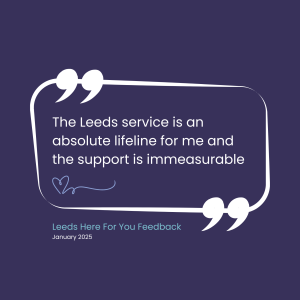
A testimonial for the Here for You service
Here For You – Touchstone
Open every day of the year, including weekends and bank holidays.
Here For You is a vital community support service offering same-day urgent mental health support across Leeds, Kirklees, and Wakefield for anyone aged 16 years or older who is experiencing emotional distress, thoughts of self-harm, or suicidal ideation.
Individuals can receive 1-to-1 support in person or over the phone from one of our trained, local staff. Free taxis are available for those who are unable to make their own way or do not feel safe to do so.
The services are open to self-referrals or referrals on behalf of others, with their consent, via an online form, which is open 24/7, or over the phone during opening hours. Opening hours for each area, along with referral numbers, are below:
- Kirklees area: 07741900395 (3:30pm – 9pm)
- Leeds: 07760173476 (3:30pm – 9pm)
- Wakefield and 5 Towns: 07776962815 (6pm – Midnight)
Website (with online referral form): https://touchstonesupport.org.uk/hereforyou/here-for-you-leeds/
Dial House – Leeds Survivor Led Crisis Service
 Dial House is a Leeds-based community support service, run by Leeds Survivor Led Crisis Service (LSLCS), offering urgent mental health support for individuals in crisis aged 16 years or older. The service offers 1-to-1 support as well as a social space where people can calmly relax in a homely environment. Dial House is open 6pm-1am in the following formats:
- In person – Every Monday, Wednesday, Friday, Saturday and Sunday
- Phone supports – Every Tuesday and Thursday
The best time for an individual to refer is between 6pm-6:45pm and this can be done by call or text on the night an individual would like support.
- Call: 0808 800 1212
- Text: 07922 249 452
Website: https://www.lslcs.org.uk/services/adult-services/dial-house-2/
National Helplines – these are all available 24 hours a day
NHS111 – for urgent medical care or mental health support, but it’s not life-threatening.
- Call: 111 (Option 2 for Mental Health Support)
- Online: https://111.nhs.uk/
Samaritans – for anyone who is struggling to cope and needs someone to talk to.
- Call: 116 123 (freephone)
- Email: jo@samaritans.org
- Write a letter
- Website: https://www.samaritans.org/how-we-can-help/contact-samaritan/
SHOUT – free and confidential text messaging service for anyone in the UK who needs support.
- Text the word ‘Shout’ to 85258
- Website: https://giveusashout.org/
Helplines for Young People
Night OWLS – for children, young people up to the age of 25, their parents and carers who live in Bradford, Leeds, Calderdale, Kirklees, Wakefield and Barnsley.
Open 8pm-8am every day of the year (Weekends and Bank Holidays included).
- Call: Freephone 0800 148 8244
- Text: 07984 376950
- Or use the button at the top of the screen to talk online https://www.lslcs.org.uk/services/cyp-services/night-owls-helpline/
Papyrus HOPELINE247 – nationwide helpline for children and young people under the age of 35 who are experiencing thoughts of suicide.
Open 24 hours every day of the year (Weekends and Bank Holidays included)
- Call: 0800 068 4141
- Text: 88247
- Email: pat@papyrus-uk.org
- Source 1 (NHS England, Adult Psychiatric Morbidity Survey: Survey of Mental Health and Wellbeing, England, 2023/4: Data tables, 2025)
- Source 2 (Office for National Statistics, Suicides in England and Wales: 1981 to 2024, 2025)
Thanks so much to the Here for You team for contributing this guest blog for the Leeds Mindful Employer Network.
If you or someone you know is struggling, the helplines and services listed above are there to help. Reaching out is a strength, and help is available.
Helplines Awareness Day is not just about knowing the helpline numbers — it’s about creating workplaces where people feel able to use them.
When employers actively normalise conversations about crisis, clearly signpost to helplines, and equip people to respond with care and confidence, they help remove shame, fear, and silence at the moments it matters most. This isn’t about replacing internal wellbeing support — it’s about recognising its limits, and ensuring people can access urgent, life-saving help when they need it.
Building a mentally healthy workplace means acknowledging the full spectrum of mental health experiences, including crisis. By embedding helpline awareness into everyday culture — through conversations, visibility, and education — employers can play a crucial role in protecting lives and supporting people through their most difficult moments.
- Download Here For You’s leaflet.
- Not part of the Leeds Mindful Employer Network yet? It’s free, quick and easy to become a member via this link.
- Find out more about signing the Mindful Employer Charter to make a public demonstration of your commitment to employee wellbeing