
Earlier this year, Leeds Mindful Employer Network Project Lead, Leigh Staunton, attended the Health & Wellbeing at Work Conference at the NEC Birmingham, focusing on sessions that echoed the themes and challenges emerging from employers across our Network.
This feature is part of Leeds Mindful Employer Network’s ‘In Practice’ series, bringing together insights from national research and real experiences from Leeds-based employers to offer practical guidance you can use right now.
The engagement gap
 A consistent question ran through many of the sessions at the Birmingham conference:
Why don’t employees engage with wellbeing support — even when it’s available?
Across conversations with employers in Leeds, this is a familiar challenge. Organisations are investing more than ever in support, yet engagement often remains low.
What emerged from the conference, however, suggests we may be asking the wrong question.
We’ve been looking at this the wrong way
One of the most important messages taken from Birmingham, particularly from a session delivered by Dr Sara Pass, Advisory Board Member at Engage for Success (EFS), was a shift in how we think about engagement, and it challenges how many organisations are currently approaching workplace wellbeing.
Engagement is often treated as the outcome of wellbeing activity.
The evidence suggests the opposite.
Engagement is one of the primary drivers of wellbeing.
 Improving engagement drivers leads to a better experience of work, and in turn, improved wellbeing.
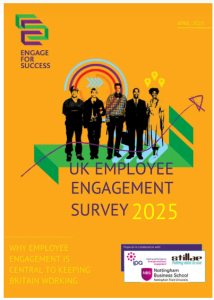
This is strongly supported by findings from EFS’ 2025 UK Employee Engagement Survey Report, which highlights that:
engagement is a key driver of performance, wellbeing and economic resilience.
This is a fundamental shift.
It means that low engagement is not just a communication problem or a participation issue — it is a signal that something in the experience of work itself is not working.
Rather than asking why employees are not engaging with wellbeing support, organisations may need to look more closely at how work is designed, experienced and managed day to day.
Why engagement matters
The EFS 2025 UK Employee Engagement Survey Report makes clear that engagement is not just a “nice to have”.
Employees with higher levels of engagement are more likely to:
- perform well and contribute to organisational outcomes
- find meaning and enjoyment in their work
- collaborate effectively and support colleagues
The data also highlights:
- employees with higher engagement are less likely to see work as just a way to earn money, and more likely to experience intrinsic satisfaction
- engagement shapes how employees experience their work, collaborate with others, and contribute beyond their core responsibilities
Alongside this, insights shared during the Birmingham session highlighted that more engaged employees are also significantly more likely to want to come to work and contribute beyond what is required (Engage for Success session, Health & Wellbeing at Work Conference, March 2026).
The disconnect in how organisations are experienced
A key theme running through both the report and the conference was inconsistency.
The EFS 2025 UK Employee Engagement Survey highlights a clear divide:
- only two in five employees report that both senior leaders and managers prioritise people issues
This disconnect is significant.
Where people issues are prioritised at all levels, engagement is higher, stress is lower, and overall experience improves. Where they are not, the opposite is true.
The report also highlights that:
- engagement can act as a protective factor, buffering individuals against stress and instability
At the same time, engagement is not experienced equally.
- disparities remain across different groups of employees, particularly those with long-term health conditions or neurodivergence
What we’re seeing locally in Leeds
These findings strongly reflect what we are hearing across the Leeds Mindful Employer Network.
Through conversations with employers, similar challenges come up repeatedly.
Support is often in place, but not always being used. Awareness does not always translate into engagement, and organisations are often unsure whether low uptake reflects low need.
What is becoming clearer is that engagement is shaped less by what is offered, and more by how work and support is experienced in practice.
What gets in the way
Both the Birmingham conference and local insight point to a number of common barriers.
Support can feel disconnected from the reality of people’s roles and workloads. Even when people are aware of what is available, they may not feel confident accessing it, particularly if there are concerns around confidentiality or how it might be perceived.
Workplace culture also plays a significant role. If people feel judged, unsure, or unsupported, they are far less likely to engage.
Managers are crucial, but may not always feel equipped to have conversations or confidently connect people to support.
What actually works in practice

The conference also highlighted what organisations are doing differently when engagement improves.
A strong starting point is focusing on how work is experienced. This means understanding workload, pressure and the day-to-day realities of different roles, and using this insight to shape support.
Making support visible and simple is also key. Clear communication, straightforward access routes and consistent messaging across teams all make a difference.
Trust plays a central role. It is built over time through consistent messages, visible leadership and positive experiences when people do speak up.
Managers are crucial to this. They do not need to be experts, but they do need to feel confident.
Supporting managers to do the following can significantly improve engagement:
– have open, supportive conversations
– understand the impact of work on wellbeing
– know what support and adjustments are available, and how to apply them in a way that is practical and meaningful in day-to-day work
Turning this into practical action for meaningful change
For employers looking to take this forward, a helpful starting point is to reflect on a few key questions about how work — and support — is experienced across your organisation.
- Do employees understand what support is available and how to access it?
- Does support reflect the reality of their roles?
- How do colleagues with different needs experience the workplace?
- Do managers feel confident in responding and signposting?
- Are different groups of employees experiencing work and support in the same way?
- And does the culture enable people to speak openly?
Resources to help
A broad range of free employer resources on engagement is available on the Engage For Success website.
Continue the conversation
Many of these themes will be explored further at our upcoming event:
Supporting Mental Health at Work: What Actually Works
📅 8 July | 📍 Leeds
This session will bring together employers to share practical insight and approaches that are making a difference in real-world settings.
Alongside this, we will also be launching our new Leeds Mindful Employer Network Toolkit, (the official name remains top secret for now – all to be revealed on the 8th July!) designed to help organisations take a more practical, structured approach to supporting mental health at work.
The Toolkit reflects many of the themes explored in this article — including the importance of leadership, job design and how work is experienced day to day — and offers a clear framework to help organisations move from intention to action.
If you’re thinking about how to improve engagement with wellbeing support, both the event and the Toolkit provide a practical starting point.
👉A small number of places are still available. Register here.
Final thought
 Low engagement doesn’t necessarily mean support isn’t valued. More often, it suggests that it doesn’t feel relevant, accessible or safe to use.
But more fundamentally, it may point to something deeper – how work itself is experienced.
If engagement is a driver of wellbeing, not just an outcome, then the focus is no longer just about encouraging people to use support.
Instead, we must widen the lens to consider how work is designed, how leadership is approached, how people are supported and what shapes the culture. All of that needs to be done intentionally in a way that makes support meaningful in the first place.
Simply enhancing your wellbeing offer isn’t enough to improve engagement.
The organisations making the most progress are paying closer attention to how work feels — day to day, role to role, and person to person.
Useful Links
Find out more about Engage for Success (EFS)
Download the EFS 2025 Employee Engagement Survey Report
Explore free resources on employer engagement from EFS
Browse EFS blogs on employee engagement
Join the Leeds Mindful Employer Network for free today.
Register your place at our 8th July event, Supporting Mental Health at Work: What Actually Works