

As organisations begin to think ahead to Men’s Health Week (June 15 – 21), it’s a useful moment to look beyond awareness and consider what meaningful support for men’s health looks like in practice in the workplace.
The publication of the Men’s Health Strategy for England in November 2025 (in line with International Men’s Day) marked an important step forward in recognising the scale of the challenge — and the role that different sectors, including employers, have to play in improving health outcomes for men.
For workplaces, this isn’t a separate issue. It connects directly to wellbeing, absence, engagement and how comfortable people feel speaking up and accessing support.
Here in Leeds, employers and partners have already been contributing to this agenda, helping to shape local conversations that feed into national thinking.
In conversation with Leeds Mindful Employer Network Project Lead, Leigh Staunton, Damian Dawtry, Project Manager of Men’s Health Unlocked and Trustee of the National Association for Male Health and Wellbeing (AMHW), shares insight from both a local and national perspective, including how work in Leeds has influenced the wider strategy and what this means in practice for employers.
Hi, Damian. Please tell us a bit about your involvement in the development of the Men’s Health Strategy for England, locally and nationally.
I was part of the local work in Leeds that fed into the national Men’s Health Strategy. Around 30 Leeds-based organisations contributed to those discussions.
A real highlight was a roundtable at Leeds Civic Hall, where more than 80 people from statutory, private and voluntary sectors came together, including Professor Alan White, the world’s first Professor of Men’s Health. It really showed the strength of the work happening in Leeds and the contribution the city has made to the national strategy.
In terms of the government’s vision and actions being taken, what stands out for you in this strategy?
The most notable thing about the Strategy is simply that it exists. It is a progressive and ambitious step.
What stands out most is the emphasis on prevention. Too often, we wait until men are in crisis. This strategy recognises the need to intervene earlier: through education, workplace engagement, community settings and digital access.
Issues such as the impact of domestic abuse on men, support for boys and the mental health consequences of separation from children deserve deeper attention and are areas that would benefit hugely from more light being placed upon them. Saying that, the strategy manages to skilfully avoid coming across as oppositional to other genders. It is fact-led, balanced and focused on reducing inequalities — particularly for men in deprived communities and high-risk occupations.
What are the most relevant themes and actions from a workplace perspective?
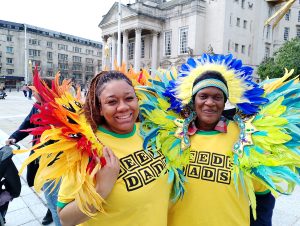
Leeds Dads’ Dadtastic Day 2025
There is a big acknowledgement within the strategy that workplaces are a fulcrum for men’s health.
It talks about men’s health in terms of occupations. For example, it lists several manual trades as being at greatest risk of death by suicide. (The notable exception to that being those within the entertainment industry.)
The Strategy also calls for better analysis of data, so we are more able to see how occupation and workplaces play into a man’s health.
It also calls for better access to healthcare for men who are working, with more men than women at work and unable to access the traditional 9-5 health services. Within that, it calls for more health education and health checks in the workplace but, aside from a few example projects, it does not talk about support put in place for the employer to do this.
Like I say, the very existence of these recommendations means that funders can be approached with some authority. This opens up, with a small dose of creativity, the potential for some nice business, Voluntary and Community sector link-ups.
Men’s Health Unlocked (MHU) has been delivering a lot of Men’s Health Awareness Sessions for workplace and community groups over the last year. What have these sessions raised about local perspectives on men’s mental health?
Often, the men are just happy that it is OK to talk about issues that affect them. I think sometimes we can hold back as men, when talking about our issues, for fear of upsetting others. No-one in the room really thinks that it’s better not to talk, so once that hurdle is overcome, the discussions start happening, and men get to hear about where they can get some support.
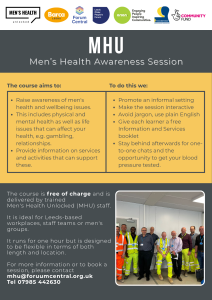
Flyer promoting MHU’s Men’s Health Awareness Sessions
What do the sessions include, what’s their purpose and what makes them impactful?
The main purpose of the sessions is to give men the opportunity to talk about their health. It is designed not only to increase knowledge but also to promote conversation and action.
Those conversations and actions are prompted by facts. We know from experience that some of those are little known – it is one of the things that I like exploring the most when delivering the session.
That said, all the MHU team is skilled in leading sensitive conversations, and we make sure that such “surprise” is not a provocation – it is just really interesting! We deliver to both single gender and mixed gender groups, and equally to employees, volunteers and clients.
We also use sensitivity to support open, safe group conversation around a subject, but also give time afterward for any individual chats – all the time, keeping the session as light as possible.
Going back to the Men’s Health Strategy, can you talk to us about the 5R Framework and how it could be adapted for workplaces?
Paul Galdas, Professor of Men’s Health at the University of York, put together a one-page checklist to translate the vision of the Men’s Health Strategy into concrete action called the 5R Framework. This has been designed with health systems, places and local authorities in mind.
I think the info does focus on systems a lot, but this makes it transferable. Below are the five principles of the 5R Framework, with some examples of how they can translate to a workplace.
- Research: What makes your workplace good for men? What makes your workforce unwell/healthy?
- Reach: How do men interact with good health (or bad health) in our workplace?
- Respond: How to we support our employees to access the care and support that they need? What about the different ways that men express their needs? What about their outside situation, e.g. families, pastimes – should/could we interact with and support that?
- Retain: Can you make your support a regular thing? How about Mental Health First Aiders? Marking International Men’s Day each year?
- Relational: Is there support beyond your own resources? What other organisations can help you?
I’m happy to talk to employers about developing their work alongside this guide to see how their day-to-day work can adapt and start to use these principles. I am sure that the economic benefits of healthy workplaces are known to all the readers here.
Can you tell our Network members about other tools from Paul Galdas that they can use to support men’s mental health in the workplace, and how these could be used?
There is so much in there that is just spot-on and useful, and done with far more exciting graphics than I have here. There is lots there that can be used, for example, healthy habits, how to talk to men, workplace culture and so forth. All bottled into a small amount of resources.
And for anyone reading this asking, “Yes but how do I make translate resources into action?”, then that is what MHU is there for. Just get in touch for a chat.
An example resource employers could utilise from Paul Galdas is: Supporting men’s mental health in the workplace: A Practical Guide for Organisations
Tell us a bit more about what you’d like to see employers work on in the months leading up to Men’s Health Week 2026 and what they could do during the week itself.
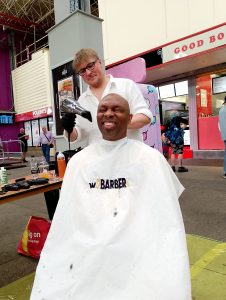
Getting a haircut at the Men’s Health Event at the market.
Men’s Health Week is a good opportunity to raise awareness of men’s health in the workplace, but this year, in honour of the Men’s Health Strategy, I’d like to see workplaces go beyond awareness to meaningful action.
I’m delighted to say that MHU will be running Northern Man Festival again this year, which occurs across Men’s Health Week. As part of that, we will be running a 5-a-side football tournament. By telling you all now, you will have plenty of time to get a work team and get into training for the coveted Northern Man Festival Trophy!
There may even be a snooker competition, open mic, and the MHU at Kirkgate Market event. Over 3,000 people attended activities at each of the last two NMFs, let’s see if we can better that this year.
To be part of the goings-on, simply sign up as an MHU Member (do this by emailing Damian.Dawtry@forumcentral.org.uk). You will then be sent the programme of activities for the week, to share with your employees. You will also be told about ways to get involved – either on your own or as part of a wider activity. For example, there are organisations that will come and deliver physical activity, presentations and even health checks across that week, MHU included.
For your own activities. I think the week is a nice excuse to do some things that remind us, as men, how we connect, where we find health and happiness, and where we find support. These do not have to be a man-only things, but can serve as a reminder of what makes men different, what they like and what they need. It could be a social event like a quiz, it could be a Bring Your Child/Pet/Piece of Art/Game to Work Day. Ask all your staff, including the women, and see what they say.
It’s a good idea, of course, to get some health information into your activities, one way or another. It does not have to be the headline of your activity (think “Health By Stealth”). This is an easy thing for MHU to support you with, including some printed materials, so get in touch if you want support with that. Also get in touch if you want to run any ideas past me or are simply not sure where to start.
As for what to do in the lead up to Men’s Health Week in June…why not start to use Prof Galdas’ guide and look at your systems at work? Do they support the health of your male employees? Do they support their connections outside of work, for example, their families? A healthy, connected man is a valuable employee.
Alternatively, if you are looking for activities to do, just take the Men’s Health Week ideas and do them any day of the year!
Thank you so much to Damian for contributing to this blog.
Damian Dawty is Project Manager of Men’s Health Unlocked, the Leeds-based network for any individual, project or organisation supporting men’s health in Leeds. Find out more on Forum Central.
He is a trustee of the national Association for Male Health and Wellbeing, and was recently listed in the inaugural list of 100 Champions for Men and Boys by the Centre for Policy Research into Men and Boys.
Damian would like to invite employers across the Network to get in touch with him on Damian.Dawtry@forumcentral.org.uk to discuss anything related to men’s health and wellbeing.
As Damian’s reflections show, improving men’s health is as much about culture as it is about provision.
For employers, the opportunity is to create environments where support is visible, conversations are normalised, and barriers to seeking help are reduced — particularly for those who may be less likely to come forward.
Through the Leeds Mindful Employer Network, we’ll continue to support employers to take practical, informed steps in this space — sharing learning, resources and examples of what works.
This is about turning strategy into something real in the workplace — and making a difference where it matters most.